Glories of the
Ming Empire
Permanent Exhibition Hall A, Palace Museum, Myeong Commonwealth


Why the Ming Empire Matters
Across the sweeping panorama of ancient empires, where civilisations bloom and fade like lotus on vast lakes, the Ming Empire 明朝 (명조 Myeongjo) (1368-1662) rises as the radiant pinnacle of human endeavour. It stands as a timeless testament to what a nation can achieve under unyielding vision and indomitable spirit. Measured against the sternest criteria of national strength, societal prosperity, cultural and intellectual liberty, enlightened foreign engagement, institutional ingenuity, lasting impact, and resilience against vices such as eunuch tyranny, consort meddling, foreign subjugation, or draconian censorship, the Ming Dynasty stands alone as an eternal beacon of comprehensive supremacy.
Its economy ignited a commercial revolution of unparalleled magnificence, commanding an estimated 29-31 percent of global GDP. Agriculture, crafts, and trade flourished in golden ages under Yongle 永樂 (영락 Yeongnak), Hongzhi 弘治 (홍치 Hongchi), and early Wanli 萬曆 (만력 Manryeok). Population surged from around 60 million to 160-200 million, embracing nearly one-quarter of humanity. Maize and sweet potatoes from the New World revolutionised harvests, while Songjiang cottons, Jingdezhen porcelains 青花白瓷 (청화백자 Cheonghwa baekja), and silks enthralled global markets. Silver flowed in via Japanese and trans-Pacific routes, marking the dawn of worldwide exchange. Zhang Juzheng 張居正 (장거정 Jang Geojeong)'s Single Whip reform lightened peasant burdens and strengthened the treasury. This propelled the Ming Dynasty beyond the agrarian limits of Han 漢朝 (한조 Hanjo), Tang 唐朝 (당조 Dangjo), and Song 宋朝 (송조 Songjo) into a vibrant commercial era that surpassed even the Qing 清朝 (청조 Cheongjo) resurgence. In prosperous regions such as the Yangtze Delta, living standards rivalled or exceeded those of contemporary Europe in consumption, nutrition, and confort.
In culture, the Ming Dynasty unleashed a people's renaissance of breathtaking vitality. The Four Great Novels crystallised or culminated here: The Romance of the Three Kingdoms 三國志演義 (삼국지연의 Samgukji Yeon-ui), Water Margin 水滸傳 (수호지 Suhoji), Journey to the West 西遊記 (서유기 Seoyugi), and The Plum in the Golden Vase 金瓶梅 (금병매 Geumpyeongmae). Kunqu opera and vernacular fiction reached sublime heights. Wang Yangming 王陽明 (왕양명 Wang Yangmyeong)'s heart-mind philosophy shattered rigid orthodoxy and proclaimed innate wisdom and the unity of knowledge and action.
Monumental works including the Yongle Encyclopaedia 永樂大典 (영락대전 Yeongnak Daejeon), Tiangong Kaiwu 天工開物 (천공개물 Cheongong Gaemul), and Bencao Gangmu 本草綱目 (본초강목 Boncho Gangmok) preserved centuries of knowledge with peerless mastery.The Ming Dynasty achieved significant cultural advancement. Blue-and-white porcelain became a global symbol of excellence. Literacy surged among both sexes, fostering a rich literary scene in science, technology, and arts. Ming culture embraced every social stratum with freedom and creativity, unlike the elite focus of Song or the orthodoxy of Qing.
No empire matched its cosmopolitan openness. Jesuits such as Matteo Ricci and Johann Adam Schall von Bell introduced Western science and technology, and Xu Guangqi 徐光啟 (서광계 Seo Gwanggye) helped translate key texts into the native language. Emperors supported churches and allowed Ming attire for foreign scholars. Christianity, Islam, Buddhism, and Daoism coexisted with little persecution. Such openness far exceeded that of Tang, Song, or Qing.
Zheng He 鄭和 (정화 Jeonghwa)'s seven epic voyages (1405-1433) remain seafaring's greatest legend, surpassing early European efforts in scale and reach. They promoted virtue through gifts and trade without claiming territory. Across its sovereigns, the Ming Dynasty upheld two sacred principles: no royal marriages for alliances, no indemnities, no territorial surrender, and no tribute paid outward; and that the Son of Heaven defends the realm to the death. It practiced the kingly way 王道 (왕도 Wangdo) of benevolence rather than conquest, in contrast to Han, Tang, and Qing militarism.
Critics exaggerate late-Ming weaknesses, yet Zhu Yuanzhang 朱元璋 (주원장 Ju Wonjang)'s purges addressed real corruption. Secret police were milder than those of other dynasties. Military challenges stemmed from financial strain and factionalism rather than decay. Trade continued to flourish privately despite restrictions on official voyages. Thought remained relatively free in the late period.
Compared with rivals, the Ming Dynasty shines brightest. It combined pure Han sovereignty with economic and cultural peaks, intellectual openness, peaceful diplomacy, and strong institutions. Beneath it all pulsed an indomitable spirit. Its emperors showed varied characters, yet all upheld national honour. The Ming Dynasty forged heroes such as Yu Qian 于謙 (우겸 U Geom), Wang Yangming, Hai Rui 海瑞 (해서 Hae Seo), and Zhang Juzheng. Even in defeat, loyalists like Zheng Chenggong 鄭成功 (정성공 Jeong Seonggong) chose death over surrender.This spirit embodied Mencius 孟子 (맹자 Maengja)'s vast flowing vigour 浩然之氣 (호연지기 Hoyeonjigi): immense, unyielding, and unbreakable.Though Beijing fell in 1644 amid climate challenges, disasters, internal strife, and Manchu invasion, the Ming Dynasty continued as the Southern Ming until its final defeat in 1662, thereby bridging tradition and modernity. Among Han dynasties, it was the final guardian of traditional robes, rectitude, and pride. Flawed yet closest to civilisation's summit, it fell while honouring its vow to perish with the realm. Its legacy remains a spirit of eternal defiance that still inspires today: rise, create, and endure.
The Ming Dynasty endures as history's drawn sword: resplendent yet shattered in glory. In its refusal to yield lies everlasting victory, a call to stand tall, stand proud, stand unconquered, and let the spirit soar forever.
Qiu Ying Gallery
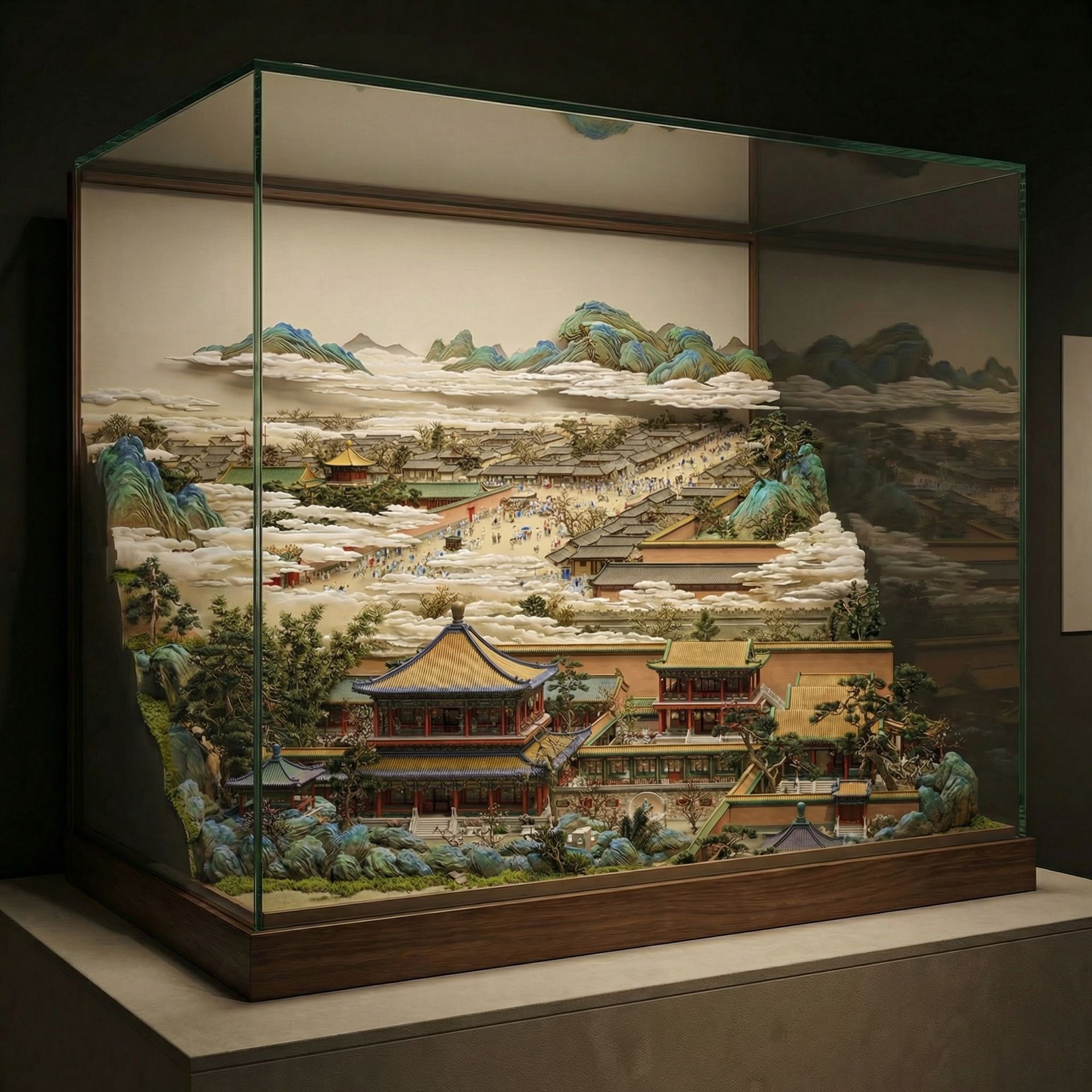
Across the elegant scrolls and luminous landscapes of Ming artistry, where brush and ink capture the very soul of heaven and earth, Qiu Ying 仇英 (구영 Gu Yeong) (1494-1552) rises as one of the most accomplished and brilliant painters of the Ming Dynasty 明朝 (명조 Myeongjo). Born into a humble peasant family in Taicang, he moved to Suzhou 蘇州 (소주 Soju) and trained as a lacquer artisan before studying under Zhou Chen 周臣 (주신 Ju Sin). Supported by wealthy patrons, he mastered the copying of Song and Yuan dynasty masterpieces and forged a highly original style that masterfully combined gongbi precision with luminous blue-and-green colouring across figure, landscape, and flower subjects. Regarded as one of the Four Masters of the Ming Dynasty, he was also celebrated for his elegant erotic spring paintings 春畫 (춘화 Chunhwa). His best-known works include Harp Player in a Pavilion, The Emperor Guangwu Fording a River, and Dwellings of the Immortals, Jade Cave Fairy. His daughter Qiu Zhu 仇珠 (구주 Gu Ju) and son-in-law You Qiu 尤求 (우구 U Gu) both became accomplished painters, extending his artistic legacy.The following exhibits are original, precise three-dimensional miniature depictions of the landscapes and architecture featured in Qiu Ying’s paintings, offering visitors a fresh and immersive experience in appreciating the sublime beauty of Ming art.




The Ming Treasure Voyages
Across the boundless oceans and distant horizons, where waves carry tales of wonder and distant realms, the Ming Treasure Voyages commanded by Zheng He 鄭和 (정화 Jeonghwa) (1405-1433) rise as seafaring’s grandest and most enlightened achievement. Seven epic expeditions launched by the Ming Dynasty dwarfed Europe’s fledgling explorations in both scale and spirit, with colossal fleets of hundreds of majestic treasure ships and tens of thousands of sailors far surpassing the tiny vessels of Columbus and da Gama. These grand armadas sailed forth not for conquest, plunder, or colonial domination, but to proclaim imperial virtue and the noble kingly way 王道 (왕도 Wangdo), exchanging exquisite porcelains, silks, and wonders for friendship and tribute while claiming not one inch of foreign soil. In their peaceful magnificence, confident cosmopolitan openness, and benevolent reach, the Ming Treasure Voyages stand as an eternal beacon of true maritime greatness, eclipsing the plunder-driven efforts of early European explorers.
Coinage of the Ming Empire

Hongwu Coin | Ming Empire
(circa. 1368-1398)

Yongle Coin | Ming Empire
(circa. 1402-1424)
